 Add to Chrome
 Add to Firefox
 Add to Edge
Knowing but Not Showing: LLMs Recognize Ambiguity but Rarely Ask Clarifying Questions
May 24, 2026
User queries are often underspecified and may admit multiple valid interpretations. Rather than silently making assumptions about the user's intent, a helpful assistant should surface such ambiguity by asking a clarifying question. Doing so requires two abilities: recognizing that a query is ambiguous, and acting on that recognition by seeking clarification instead of answering directly. To study these abilities, we evaluate models on ambiguous, unambiguous, and disambiguated questions in three settings: standard question answering, explicit ambiguity judgment, and behavioral analysis, where a judge model classifies responses as direct answers, refusals, or clarifying questions. We find a clear gap between recognition and behavior: models often identify ambiguity when explicitly asked to judge it, yet in the QA setting they overwhelmingly default to direct answers. Retrieved context further widens this gap by improving answerability while making models even less likely to ask clarifying questions.

Token-weighted Direct Preference Optimization with Attention
May 21, 2026Direct Preference Optimization (DPO) aligns Large Language Models with human preferences without the need for a separate reward model. However, DPO treats all tokens in responses equally, neglecting the differing importance of individual tokens. Existing token-level PO methods compute the token weights using either token-position-based heuristic functions or probability estimates given by a separately trained model, which lacks robustness and incurs extra training cost. In contrast, we propose Token-weighted DPO (TwDPO) -- a novel training objective grounded on token-weighted RL -- and AttentionPO -- an instantiation of TwDPO that uses attention from the LLM itself to estimate token weights. AttentionPO prompts the LLM to serve as a pairwise judge and check where the model attends when comparing the responses. This design makes AttentionPO content-aware, adjusting weights based on response content, and efficient, incurring only two extra forward passes per example. Experiment results show that AttentionPO significantly improves performance on AlpacaEval, MT-Bench, and ArenaHard, surpassing existing Preference Optimization methods.
How Far Are We From True Auto-Research?
May 18, 2026Recent auto-research systems can produce complete papers, but feasibility is not the same as quality, and the field still lacks a systematic study of how good agent-generated papers actually are. We introduce ResearchArena, a minimal scaffold that lets off-the-shelf agents (Claude Code using Opus 4.6, Codex using GPT-5.4, and Kimi Code using K2.5) carry out the full research loop themselves (ideation, experimentation, paper writing, self-refinement) under only lightweight guidance. Across 13 computer science seeds and 3 trials per agent-domain pair, ResearchArena yields 117 agent-generated papers, each evaluated under three complementary lenses: a manuscript-only reviewer (SAR), an artifact-aware peer review (PR) in which agents inspect the workspace alongside the manuscript, and an human conducted meta-review. Under SAR alone the picture is optimistic: Claude Code obtains the highest score, outperforms Analemma's FARS, and matches the weighted-average human ICLR 2025 submission, suggesting that minimally scaffolded agents can produce papers that look competitive on manuscript-only review. Manual inspection, however, reveals this picture is overstated: SAR scores are poorly aligned with its actual acceptance decisions and reward plausible framing without verifying experimental substance. Under artifact-aware PR scores drop sharply, and manual auditing identifies experimental rigor as the major bottleneck, decomposing into three failure modes (fabricated results, underpowered experiments, and plan/execution mismatch) that are highly agent-dependent: Codex 5%/8% paper-vs-artifact mismatch / fabricated references versus Kimi Code 77%/72%, a $\sim$15$\times$ spread that tracks distinct research personas the agents develop. None of the 117 agent-generated papers reaches the acceptance bar of a top-tier venue. This suggests that we are still gapped from the true auto-research.
Bootstrapping Post-training Signals for Open-ended Tasks via Rubric-based Self-play on Pre-training Text
Apr 21, 2026Self-play has recently emerged as a promising paradigm to train Large Language Models (LLMs). In self-play, the target LLM creates the task input (e.g., ask a question), which it then addresses itself by producing a task output (e.g., give an answer). A reward model evaluates the output, and the rewards are then used to train the LLM, typically via Reinforcement Learning (RL). Self-play incurs minimal supervision costs, and this is especially helpful for post-training LLMs, which require high-quality input-output pairs that traditionally have to be written by humans or expensive proprietary models. However, existing work explores self-play only for verifiable tasks such as math and coding. Instead, we seek to extend it to more realistic open-ended tasks. In particular, we propose POP, a self-play framework that uses the same LLM to synthesize evaluation rubrics, along with input-output pairs, for each example. The rubric is then used to evaluate outputs and train the model. We further ground the framework on a content-rich pretraining corpus to (1) ensure a generation-verification gap and reduce reward hacking, and (2) prevent mode collapse. On Qwen-2.5-7B, POP increases performance of both pretrained and instruction-tuned models, across different tasks ranging from long-form Healthcare QA to creative writing and instruction following.
FIRE-Bench: Evaluating Agents on the Rediscovery of Scientific Insights
Feb 02, 2026Autonomous agents powered by large language models (LLMs) promise to accelerate scientific discovery end-to-end, but rigorously evaluating their capacity for verifiable discovery remains a central challenge. Existing benchmarks face a trade-off: they either heavily rely on LLM-as-judge evaluations of automatically generated research outputs or optimize convenient yet isolated performance metrics that provide coarse proxies for scientific insight. To address this gap, we introduce FIRE-Bench (Full-cycle Insight Rediscovery Evaluation), a benchmark that evaluates agents through the rediscovery of established findings from recent, high-impact machine learning research. Agents are given only a high-level research question extracted from a published, verified study and must autonomously explore ideas, design experiments, implement code, execute their plans, and derive conclusions supported by empirical evidence. We evaluate a range of state-of-the-art agents with frontier LLMs backbones like gpt-5 on FIRE-Bench. Our results show that full-cycle scientific research remains challenging for current agent systems: even the strongest agents achieve limited rediscovery success (<50 F1), exhibit high variance across runs, and display recurring failure modes in experimental design, execution, and evidence-based reasoning. FIRE-Bench provides a rigorous and diagnostic framework for measuring progress toward reliable agent-driven scientific discovery.
MovieRecapsQA: A Multimodal Open-Ended Video Question-Answering Benchmark
Jan 05, 2026Understanding real-world videos such as movies requires integrating visual and dialogue cues to answer complex questions. Yet existing VideoQA benchmarks struggle to capture this multimodal reasoning and are largely not open-ended, given the difficulty of evaluating free-form answers. In this paper, we introduce a novel open-ended multi-modal VideoQA benchmark, MovieRecapsQA created using movie recap videos--a distinctive type of YouTube content that summarizes a film by presenting its key events through synchronized visual (recap video) and textual (recap summary) modalities. Using the recap summary, we generate $\approx 8.2$ K question-answer (QA) pairs (aligned with movie-subtitles) and provide the necessary "facts" needed to verify an answer in a reference-free manner. To our knowledge, this is the first open-ended VideoQA benchmark that supplies explicit textual context of the input (video and/or text); which we use for evaluation. Our benchmark provides videos of multiple lengths (i.e., recap-segments, movie-segments) and categorizations of questions (by modality and type) to enable fine-grained analysis. We evaluate the performance of seven state-of-the-art MLLMs using our benchmark and observe that: 1) visual-only questions remain the most challenging; 2) models default to textual inputs whenever available; 3) extracting factually accurate information from video content is still difficult for all models; and 4) proprietary and open-source models perform comparably on video-dependent questions.
Better LLM Reasoning via Dual-Play
Nov 19, 2025Large Language Models (LLMs) have achieved remarkable progress through Reinforcement Learning with Verifiable Rewards (RLVR), yet still rely heavily on external supervision (e.g., curated labels). Adversarial learning, particularly through self-play, offers a promising alternative that enables models to iteratively learn from themselves - thus reducing reliance on external supervision. Dual-play extends adversarial learning by assigning specialized roles to two models and training them against each other, fostering sustained competition and mutual evolution. Despite its promise, adapting dual-play training to LLMs remains limited, largely due to their susceptibility to reward hacking and training instability. In this paper, we introduce PasoDoble, a novel LLM dual-play framework. PasoDoble adversarially trains two models initialized from the same base model: a Proposer, which generates challenging questions with ground-truth answers, and a Solver, which attempts to solve them. We enrich the Proposer with knowledge from a pre-training dataset to ensure the questions' quality and diversity. To avoid reward hacking, the Proposer is rewarded for producing only valid questions that push the Solver's limit, while the Solver is rewarded for solving them correctly, and both are updated jointly. To further enhance training stability, we introduce an optional offline paradigm that decouples Proposer and Solver updates, alternately updating each for several steps while holding the other fixed. Notably, PasoDoble operates without supervision during training. Experimental results show that PasoDoble can improve the reasoning performance of LLMs. Our project page is available at https://hcy123902.github.io/PasoDoble.
Thinking Fast and Right: Balancing Accuracy and Reasoning Length with Adaptive Rewards
May 23, 2025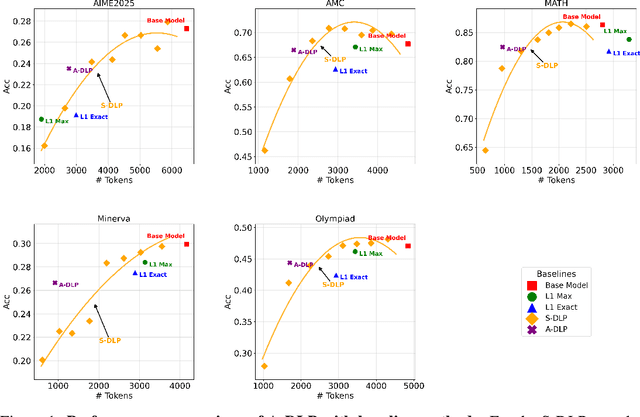
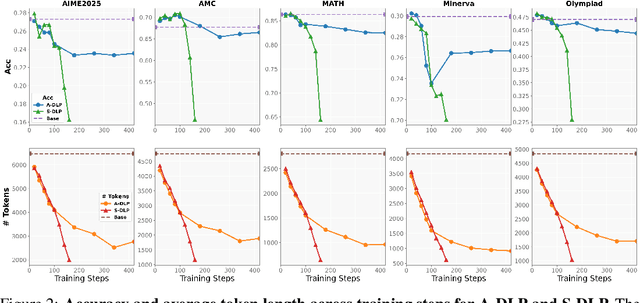
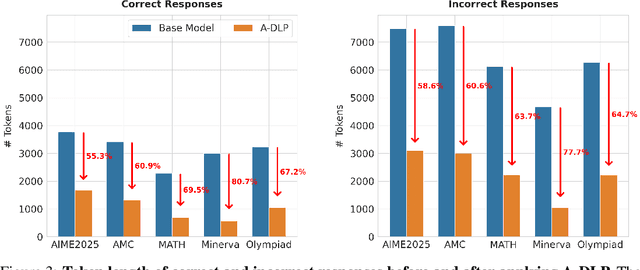
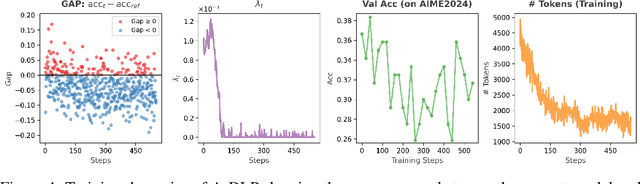
Large language models (LLMs) have demonstrated strong reasoning abilities in mathematical tasks, often enhanced through reinforcement learning (RL). However, RL-trained models frequently produce unnecessarily long reasoning traces -- even for simple queries -- leading to increased inference costs and latency. While recent approaches attempt to control verbosity by adding length penalties to the reward function, these methods rely on fixed penalty terms that are hard to tune and cannot adapt as the model's reasoning capability evolves, limiting their effectiveness. In this work, we propose an adaptive reward-shaping method that enables LLMs to "think fast and right" -- producing concise outputs without sacrificing correctness. Our method dynamically adjusts the reward trade-off between accuracy and response length based on model performance: when accuracy is high, the length penalty increases to encourage faster length reduction; when accuracy drops, the penalty is relaxed to preserve correctness. This adaptive reward accelerates early-stage length reduction while avoiding over-compression in later stages. Experiments across multiple datasets show that our approach consistently and dramatically reduces reasoning length while largely maintaining accuracy, offering a new direction for cost-efficient adaptive reasoning in large-scale language models.
HAPO: Training Language Models to Reason Concisely via History-Aware Policy Optimization
May 16, 2025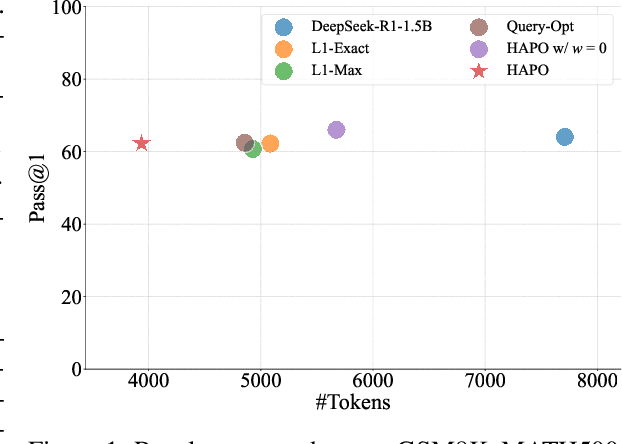
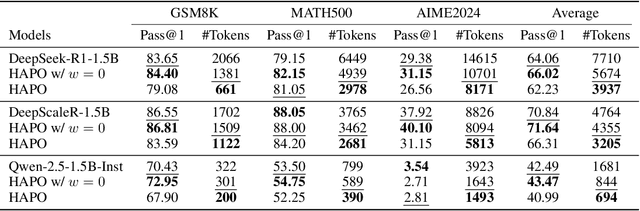
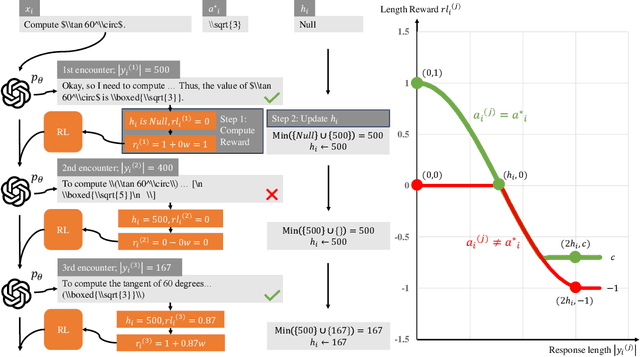
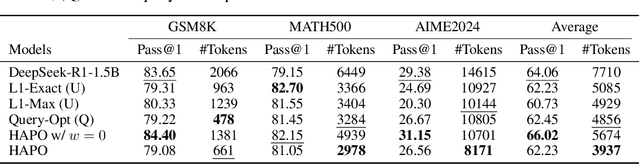
While scaling the length of responses at test-time has been shown to markedly improve the reasoning abilities and performance of large language models (LLMs), it often results in verbose outputs and increases inference cost. Prior approaches for efficient test-time scaling, typically using universal budget constraints or query-level length optimization, do not leverage historical information from previous encounters with the same problem during training. We hypothesize that this limits their ability to progressively make solutions more concise over time. To address this, we present History-Aware Policy Optimization (HAPO), which keeps track of a history state (e.g., the minimum length over previously generated correct responses) for each problem. HAPO employs a novel length reward function based on this history state to incentivize the discovery of correct solutions that are more concise than those previously found. Crucially, this reward structure avoids overly penalizing shorter incorrect responses with the goal of facilitating exploration towards more efficient solutions. By combining this length reward with a correctness reward, HAPO jointly optimizes for correctness and efficiency. We use HAPO to train DeepSeek-R1-Distill-Qwen-1.5B, DeepScaleR-1.5B-Preview, and Qwen-2.5-1.5B-Instruct, and evaluate HAPO on several math benchmarks that span various difficulty levels. Experiment results demonstrate that HAPO effectively induces LLMs' concise reasoning abilities, producing length reductions of 33-59% with accuracy drops of only 2-5%.
Between Underthinking and Overthinking: An Empirical Study of Reasoning Length and correctness in LLMs
Apr 30, 2025Large language models (LLMs) are increasingly optimized for long reasoning, under the assumption that more reasoning leads to better performance. However, emerging evidence suggests that longer responses can sometimes degrade accuracy rather than improve it. In this paper, we conduct a systematic empirical study of the relationship between reasoning length and answer correctness. We find that LLMs tend to overthink simple problems, generating unnecessarily long outputs, and underthink harder ones, failing to extend their reasoning when it is most needed. This indicates that models might misjudge problem difficulty and fail to calibrate their response length appropriately. Furthermore, we investigate the effects of length reduction with a preference optimization algorithm when simply preferring the shorter responses regardless of answer correctness. Experiments show that the generation length can be significantly reduced while maintaining acceptable accuracy. Our findings highlight generation length as a meaningful signal for reasoning behavior and motivate further exploration into LLMs' self-awareness in reasoning length adaptation.